Past Issues:
Author: Lynn Wilson
-
WRCY420 Weston Mt Analog,462.625MHz
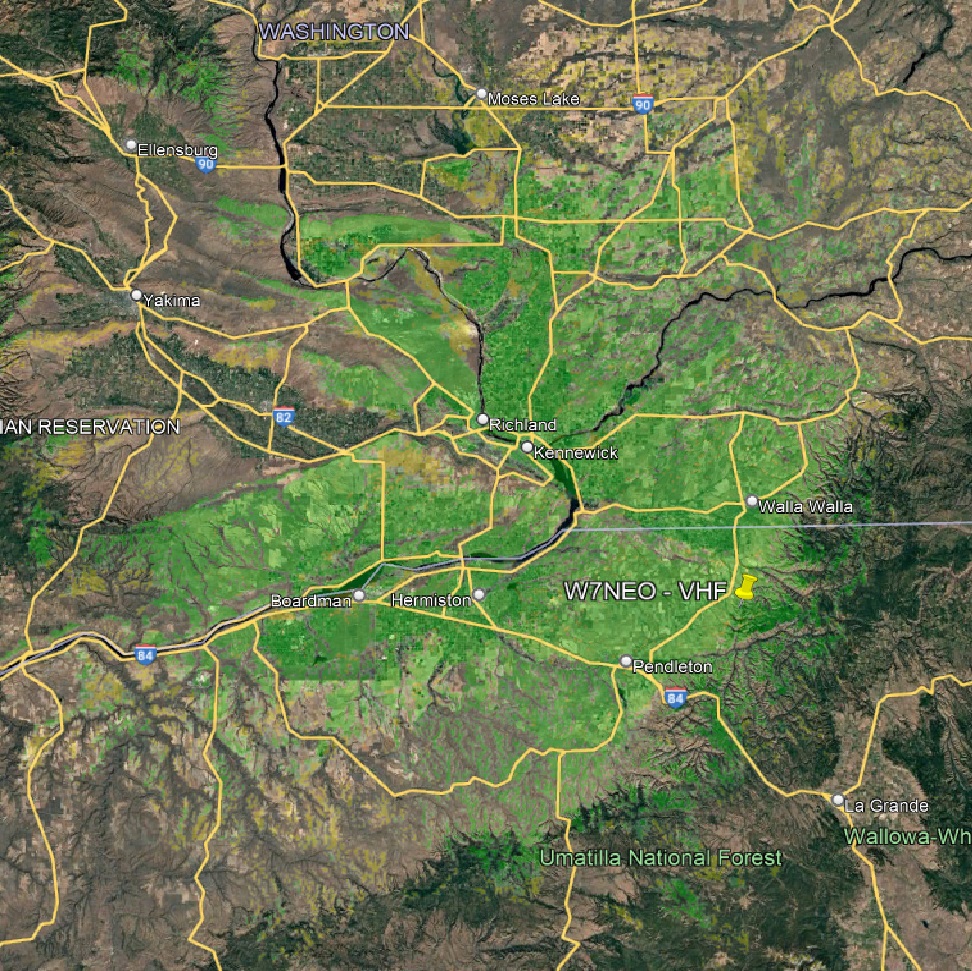
Based upon the success of our Cabbage Hill GMRS experiment, it was decided to commission a second GMRS repeater on our Weston Mt site. This would provide coverage into Milton-Freewater, along with the Walla Walla Valley, and the Tri-Cities area in eastern Washington.
Location Weston Mt Oregon, Just off OR-204 Frequency 462.650MHz Offset Positive 5.0MHz DCS 073 Mode FM Repeater Make/Model Kenwood TKR-850 Elevation 3,000 ft Antenna DB408-B Antenna Height 45 ft Control Operators Mike Gemelke, WRCY420
Lynn Wilson, WRYF803Coverage Map
-
N7NKT Cabbage Hill, 224.560
This repeater belongs to a long-time member of the WMDA who’s help in building this system over the years has been invaluable. So when he lost his long time site where this repeater was prior to relocating to Cabbage Hill, it was a no brainer to move his machine into the W7NEO Cabbage Hill site.
Location Cabbage Hill (I84 20 miles E of Pendleton near the weigh station) Frequency 224.56MHz Offset Negative 1.6MHz PL 118.8Hz Mode FM Repeater Make/Model Bridgecom Elevation 3562 ft Antenna Antenna Height 15 ft Control Operators Mike Gemelke, N7NKT Coverage Map
0
-
WRYF803 Cabbage Hill GMRS 462.625MHZ
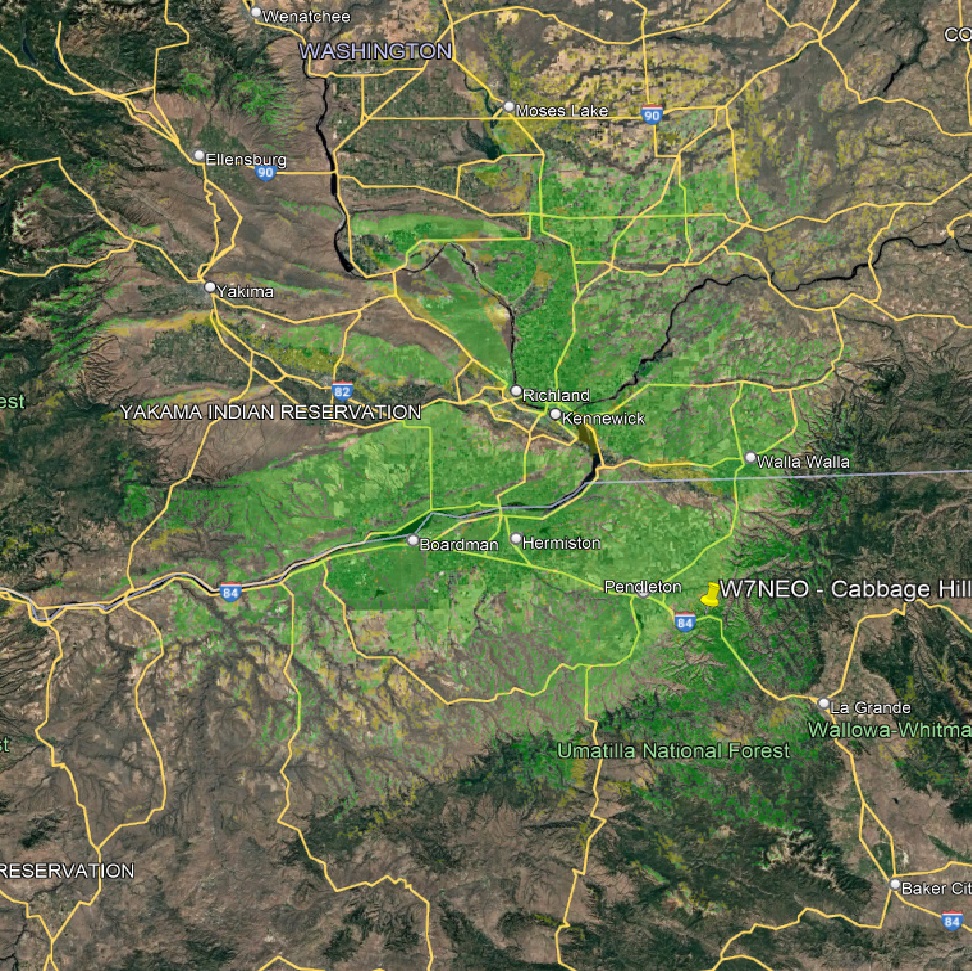
This intially began as an experiment brought about by the urging of some local Ham Operators in order to provide much needed GMRS repeater coverage in the area. It was originally agreed upon to go with a three-month probationary period to see how it would work out. It’s been almost three years now without any problems. That said, it would appear that the “experiment” has been a success.
Location Cabbage Hill (I84 20 miles E of Pendleton near the weigh station) Frequency 462.625MHz Offset Positive 5.0MHz PL 131.8Hz Mode FM Repeater Make/Model Kenwood TKR-850 Elevation 3562 ft Antenna Commspec DB408L Antenna Height 45 ft Control Operators Lynn Wilson, WRYF803
Mike Gemelke, WRCY420Coverage Map
-
W7NEO Cabbage Hill Digital Repeater 444.975
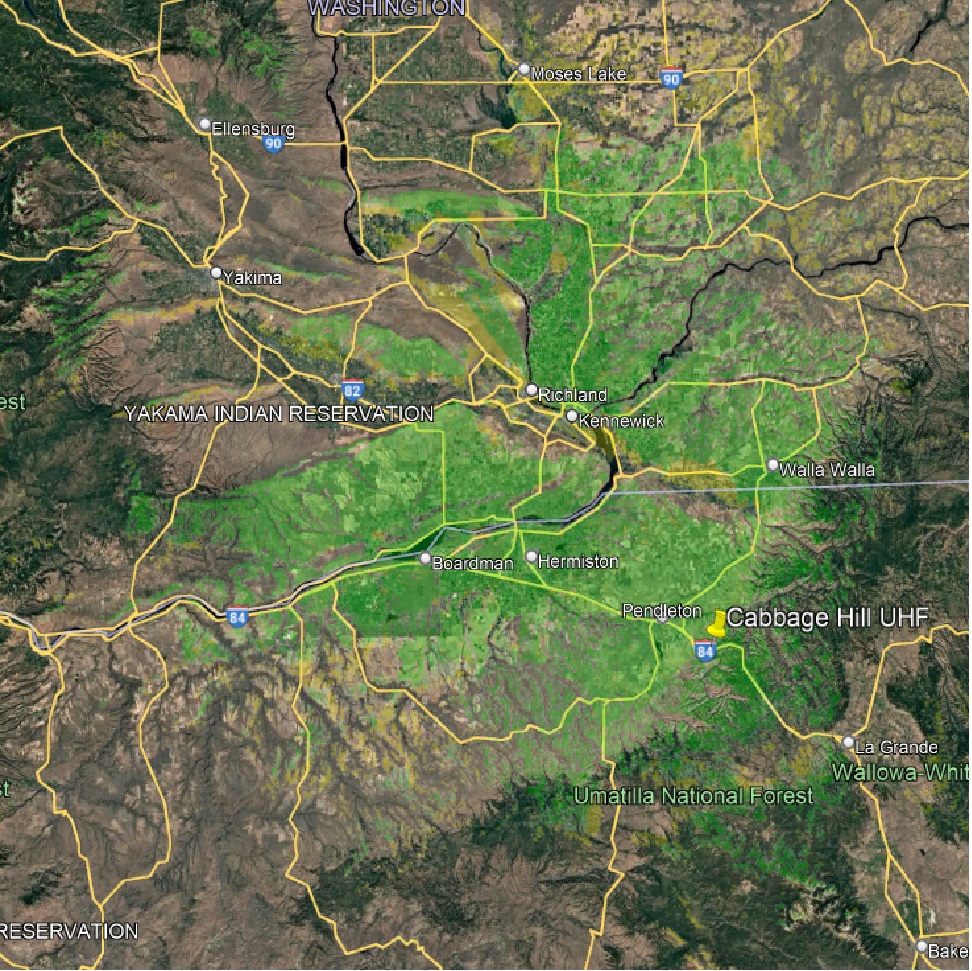
The “Cabbage Hill 975” repeater is our adopted site. It was previously part of another club and that club disbanded. It later went completely off the air due to equipment failure. We replaced the old analog repeater which had been off the air for a number of years with a new Fusion repeater and placed it back on the air as part of our C4FM digital voice system.
Location Cabbage Hill (I84 20 miles E of Pendleton near the weigh station) Frequency 444.975MHz Offset Positive 5MHz PL Tone Linking WiresX to NE-Oregon Room (40289) Mode C4FM Fusion Repeater Make/Model Yaesu DR-2X Elevation 3562 ft Antenna Super Station Master Antenna Height 34 ft Control Operator
Lynn Wilson (K7LW)Coverage Map
-
W7NEO Weston Mountain Digital Repeater 147.040
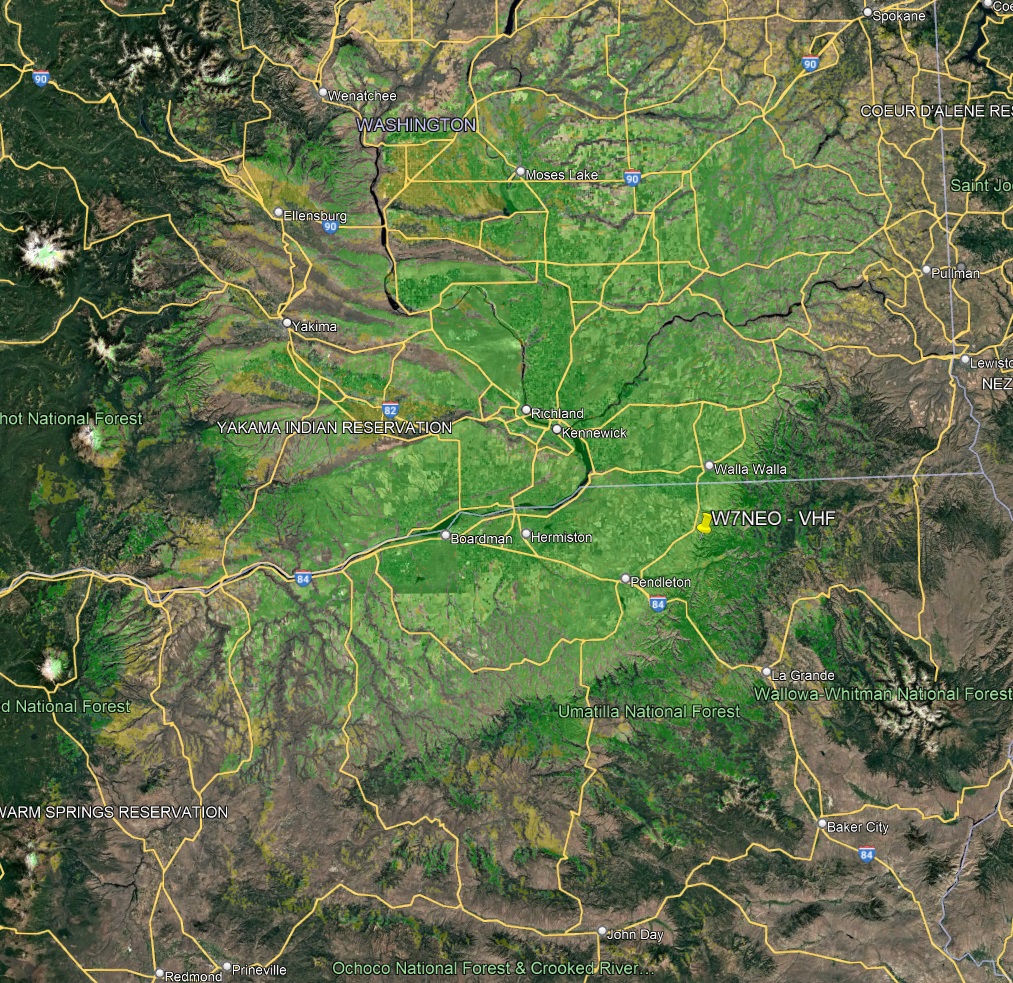
The Original Weston Mountain repeater not only was the first of the system, it marked the very beginning of the system, and is what eventually gave our little group it’s name.
Location Weston Mountain (above Weston, OR) Frequency 147.040MHz Offset Positive 0.6MHz PL Tone None Linking WiresX to NE-Oregon Room (40289) Mode C4FM/Yaesu Digital Fusion ONLY Repeater Make/Model Yaesu DR-2X Elevation 2950 ft Antenna Sinclair SC246 Antenna Height 35 ft Control Operator
Lynn Wilson (K7LW)Coverage Map
-
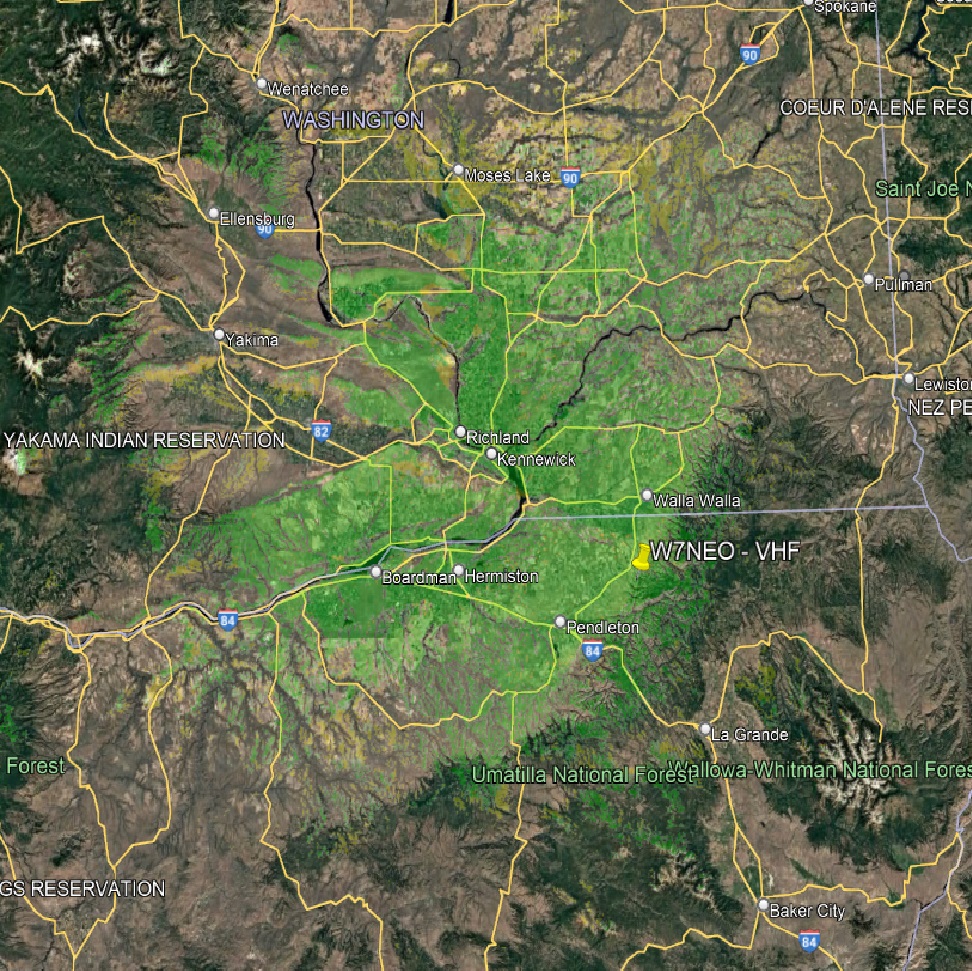
W7NEO Weston Mountain Analog Repeater 441.700
The analog repeater on Weston Mountain was originally setup for a couple of local UPS drivers so they could talk to one another as they were returning back to their home bases. Both have since retired, with one now a silent key. Since that time it has become a local mainstay for many local Hams to use and enjoy. Additionally, because of its excellent coverage, it is used as a backup for the Walla Walla Emergency Communications folks. Currently this repeater is connected to our remaining analog repeaters via AllStar. All this helps to provide a valuable resource to our local Ham community for those that either haven’t the ability or the desire to explore digital voice communications.
If you aren’t familiar with AllStar, you can find out more here.
Location Weston Mountain (above Weston, OR) Frequency 441.700MHz Offset Positive 5MHz PL Tone 131.8Hz Linking Allstar Mode FM Analog Repeater Make/Model Kenwood NXR-810 Elevation 2950 ft Antenna Super Station Master Antenna Height 35 ft Control Operator
Lynn Wilson (K7LW)Coverage Map
-
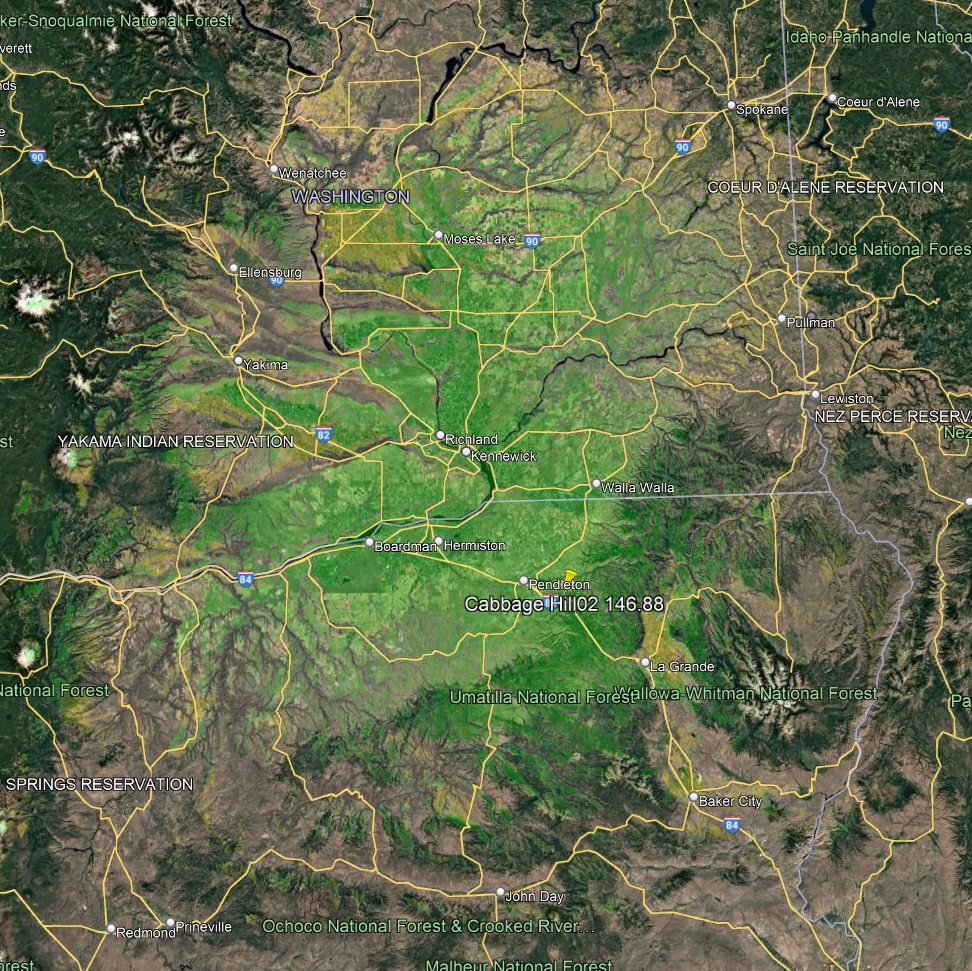
W7NEO Cabbage Hill Analog Repeater 146.880
The “Cabbage Hill 88” repeater is our adopted site. It was previously part of another club which has since disbanded. It later went completely off the air due to equipment failure, and remained off the air for over three years. We replaced the failed repeater with a new, and much improved repeater thereby putting the repeater back on the air. The local history of this repeater spans just over forty years, so the renovation of this site was particularly important to us. It is also linked to our other analog repeaters via Allstar.
If you aren’t familiar with AllStar, you can find out more here.
Location Cabbage Hill (I84 20 miles E of Pendleton near the weigh station) Frequency 146.880MHz Offset Negative 0.6MHz DCS 073 Linking Allstar Mode FM Repeater Make/Model Kenwood NXR-710 Elevation 3562 ft Antenna Sinclair SC246 Antenna Height 45 ft Control Operators
Lynn Wilson (K7LW) PRIMARY
Emery Heintz (KE7YX)
Mike Gemelke (N7NKT)Coverage Map
-
73’s, A bit of background
Many amateurs already know that “73” is from what is known as the “Phillips Code”, a series of numeric messages conceived for the purpose of cutting down transmission time on the old land telegraph systems when sending text that is basically the same.
In the April 1935 issue of QST on page 60 there is a short article on the origin of 73. This article was a summation of another article that appeared in the “December Bulletin from the Navy Department Office of the Chief of Naval Operations”. That would be December of 1934.
The quotation from the Navy is as follows: “It appears from a research of telegraph histories that in 1859 the telegraph people held a convention, and one of its features was a discussion as to the saving of ‘line time’. A committee was appointed to devise a code to reduce standard expressions to symbols or figures. This committee worked out a figure code, from figure 1 to 92. Most of these figure symbols became obsolescent, but a few remain to this date, such as 4, which means “Where shall I go ahead?’. Figure 9 means ‘wire’, the wire chief being on the wire and that everyone should close their keys. Symbol 13 means ‘I don’t understand’; 22 is ‘love and a kiss’; 30 means ‘good night’ or ‘the end’. The symbol most often used now is 73, which means ‘my compliments’ and 92 is for the word ‘deliver.’ The other figures in between the forgoing have fallen into almost complete disuse.”
One of the chief telegraphers of the Navy Department of Communications, a J. L. Bishop, quoted from memory the signals that were in effect in 1905:
1     Wait a minute
4     Where shall I start in message?
5     Have you anything for me?
9     Attention or clear the wire
13    I do not understand
22    Love and kisses
25    Busy on another circuit
30    Finished, the end-used mainly by press telegraphers
73    My compliments, or Best Regards
92    Deliver
Now days, 22 has become 88 (love and kisses). I don’t know when this came about. 30 is still used in the newspaper and magazine business to indicate the end of a feature, story, or column. And, of course, 73 is still used by amateur radio operators to mean “best regards”.
Making any of these numbers plural (73s, 88s, etc.) is incorrect since they are already plural. 73s would mean best regards and 88s would mean love and kisses. Those make no sense.
Anyway, the subject of where 73 came from comes up periodically and this article reinforces the “Phillips Code” origin.
Some other related stuff:
Phillips Code “19” and “31” refer to train orders. They were so well known that the terms “19 order” and “31 order” were still in RR use in the 1970s, long after the telegraph was gone.
The abbreviation “es” for “and” derives from the Morse character “&”. The prosign “SK” with the letters run together derives from the Morse “30”.
The numeric code is a small part of the abbreviations outlined in the Phillips Code (developed by telegrapher Walter P. Phillips). Here are the numbers as referenced:
WIRE SIGNALS
WIRE     Preference over everything except 95
    1     Wait a moment
    2     Important Business
    3     What time is it?
    4     Where shall I go ahead?
    5     Have you business for me?
    6     I am ready
    7     Are you ready?
    8     Close your key; circuit is busy
    9     Close your key for priorit business (Wire chief, dispatcher, etc)
    10     Keep this circuit closed
    12     Do you understand?
    13     I understand
    14     What is the weather?
    15     For you and other to copy
    17     Lightning here
    18     What is the trouble?
    19     Form 19 train order
    21     Stop for a meal
    22     Wire test
    23     All copy
    24     Repeat this back
    25     Busy on another wire
    26     Put on ground wire
    27     Priority, very important
    28     Do you get my writing?
    29     Private, deliver in sealed envelope
    30     No more (end)
    31     Form 31 train order
    32     I understand that I am to …
    33     Car report (Also, answer is paid for)
    34     Message for all officers
    35     You may use my signal to answer this
    37     Diversion (Also, inform all interested)
    39     Important, with priority on thru wire (Also, sleep-car report)
    44     Answer promptly by wire
    73     Best regards
    88     Love and kisses
    91     Superintendant's signal
    92     Deliver promptly
    93     Vice President and General Manager's signals
    95     President's signal
    134    Who is at the key?